

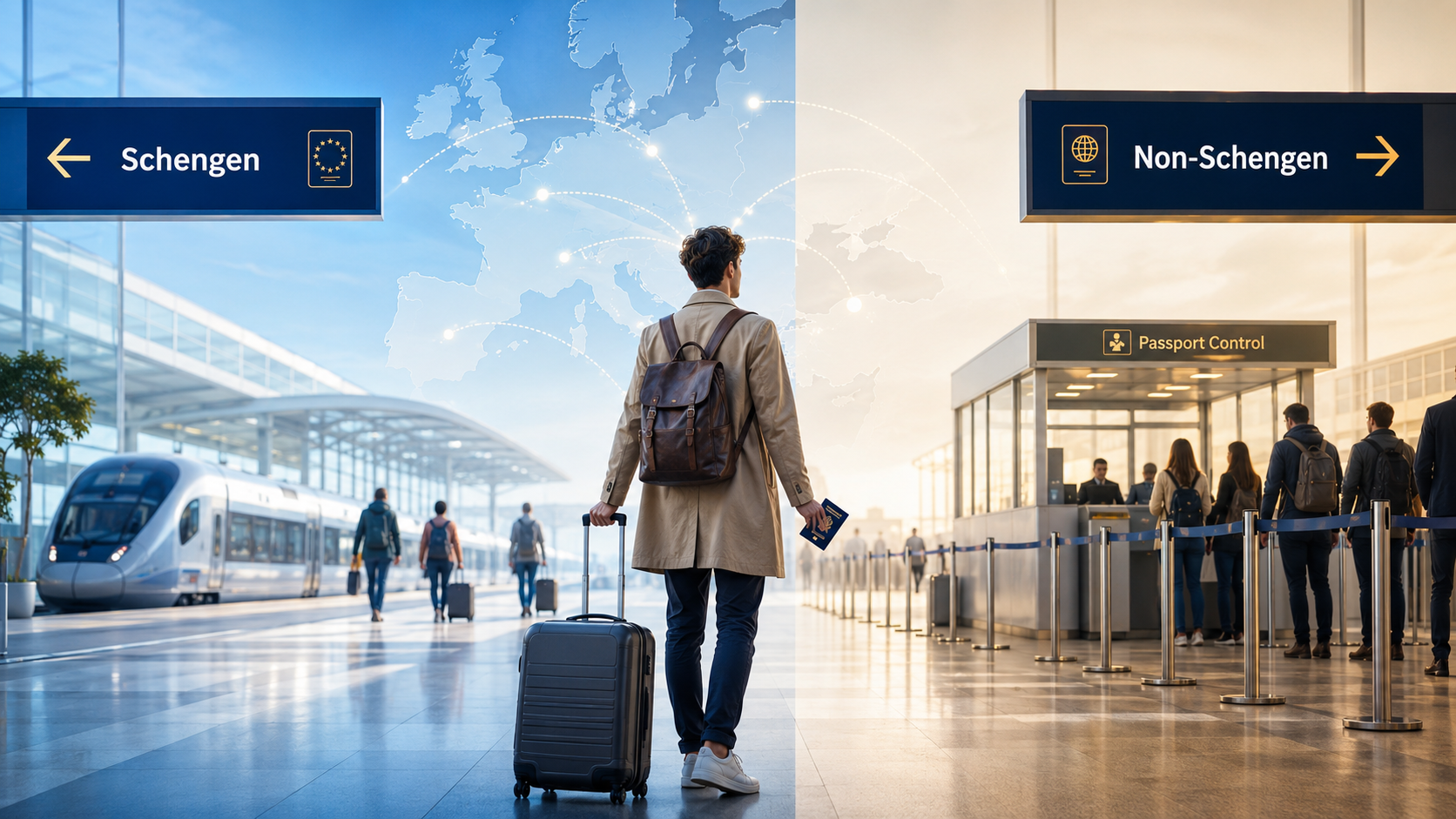
Schengen vs Non-Schengen: What It Actually Means for Your Daily Life in Europe
Moving to Europe, travelling across borders, applying for a visa, or planning a long-term stay often brings up one confusing question: what is the actual difference between Schengen and non-Schengen countries?
At first glance, the Schengen Area may sound like a purely political or legal concept. But in real life, it can affect how you travel, how often your passport is checked, how long you can stay, where you can legally work, and even how you plan simple weekend trips.
This guide explains the difference between Schengen and non-Schengen countries in practical, everyday terms — without complicated legal language.
What Is the Schengen Area?
The Schengen Area is a group of European countries that have removed regular passport checks at their shared internal borders. In practice, this means that travelling from one Schengen country to another often feels similar to travelling between regions inside one country.
For example, if you travel from France to Germany, or from Italy to Austria, you usually do not go through traditional passport control at the border.
As of 2026, the Schengen Area includes 29 countries: most EU member states plus Iceland, Norway, Switzerland, and Liechtenstein.
But here is the important part: Schengen is not the same thing as the European Union.
Some countries are in the EU but not in Schengen. Some countries are in Schengen but not in the EU. This is where many people get confused.
Schengen vs EU: Why People Mix Them Up
The European Union is a political and economic union. The Schengen Area is mainly about border control and short-term travel rules.
That means a country can be:
- in the EU and in Schengen;
- in the EU but outside Schengen;
- outside the EU but inside Schengen;
- outside both.
For daily life, this distinction matters because your visa, residence permit, work rights, border experience, and travel freedom may depend on which category applies.
Quick Comparison: Schengen vs Non-Schengen
| Topic | Schengen Countries | Non-Schengen Countries |
|---|---|---|
| Border checks | Usually no routine checks between Schengen countries | Passport control usually applies |
| Short-stay rule | Common 90 days in any 180-day period for many non-EU visitors | Rules depend on each country |
| Visa system | Schengen visa usually covers the whole Schengen Area | National visa rules usually apply |
| Residence permit | Usually valid for residence in one country, not all Schengen countries | Depends on national law |
| Work rights | Based on your specific permit, not the whole Schengen Area | Based on national immigration rules |
| Travel planning | Easier for multi-country trips | More border and visa planning needed |



What Schengen Means for Daily Travel
For tourists, digital nomads, business travellers, and new residents, the most visible benefit of Schengen is easier movement.
Once you are legally inside the Schengen Area, you can usually travel between Schengen countries without going through routine border checks. This makes weekend trips, train travel, road trips, and multi-country itineraries much easier.
For example, you could fly into Spain, take a train to France, continue to Belgium, and then visit the Netherlands without separate border procedures at each step.
However, this does not mean there are no rules. Police checks can still happen inside countries, and temporary border controls may be introduced in specific situations. But the general experience is still much smoother than crossing external borders.
The 90/180 Rule: The Most Important Schengen Rule for Visitors
For many non-EU nationals, the key Schengen rule is the 90 days in any 180-day period limit. This applies to short stays for tourism, business visits, family visits, and similar purposes.
In simple terms, you cannot stay in the Schengen Area indefinitely just by moving from one Schengen country to another. The whole Schengen Area is counted together for short-stay purposes.
So, spending:
- 30 days in Italy,
- 30 days in Germany,
- 30 days in Spain,
usually equals 90 days in Schengen total.
After that, you may need to leave the Schengen Area until enough days pass in the rolling 180-day window.
Frequently Asked Questions
It's the right question to ask — there are real scams in this industry, and we know it. You can verify us any time: check our official company registration in Slovakia, read 287+ Google reviews, watch 100+ video testimonials from clients around the world. We've been working since 2018. Everything about us is publicly verifiable — we genuinely encourage you to check before trusting us with anything.
This is the answer to the question.
This is the answer to the question.
It depends on the country you choose. Fastest options: Ukraine ~1 month; Serbia and Czech Republic (seasonal) 1–2 months; Montenegro ~2 months; Hungary ~2.5 months. Standard EU: Slovakia 3–4 months; Poland 4–6 months. Western Europe: Norway 3–5 months; Germany 3–6 months. Your dedicated advisor will give you a realistic personal timeline once you pick your destination.
This is the answer to the question.
This is the answer to the question.
Not right away — family reunification is a separate process that starts after you've built legal residency, typically after 1–2 years in the country. The good news: once you're settled and your permit is in order, you can start that process yourself through official channels. It's very doable, and many people who came through our program have done it successfully.
How useful was this post?
Click on a star to rate it!
Average rating / 5. Vote count:
No votes so far! Be the first to rate this post.